
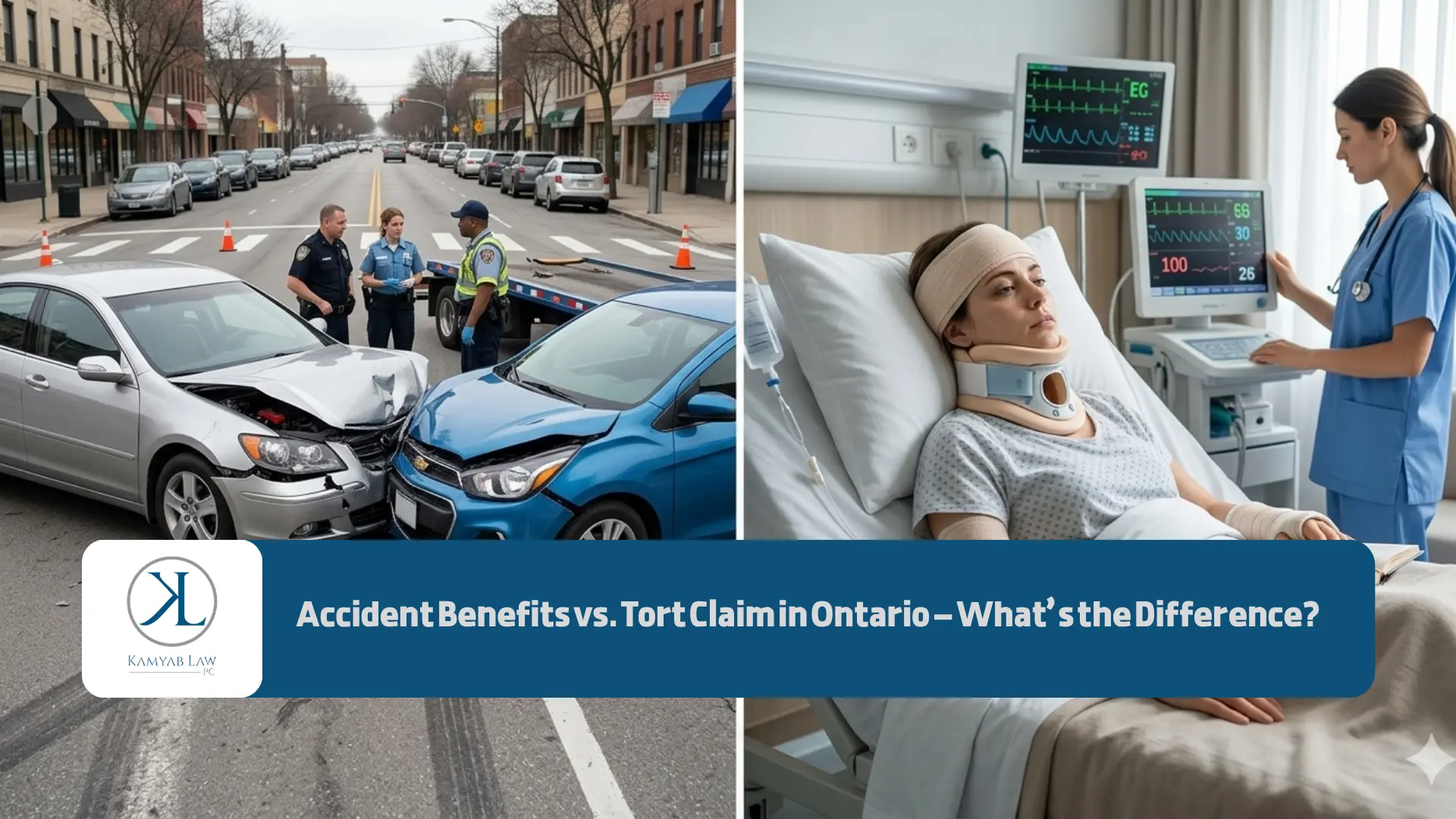
If you’ve been injured in a car accident in Ontario, you may quickly hear two legal terms:
Accident Benefits and Tort Claim.
For many accident victims, the difference between these two systems is confusing. People often assume they must choose one or the other. In reality, both systems may apply to the same accident, but they serve different purposes.
Understanding how these two types of claims work is essential if you want to protect your rights and avoid leaving compensation on the table.
Below is a clear breakdown of how Accident Benefits and Tort Claims differ under Ontario law.
The Two Compensation Systems After a Car Accident
Ontario uses a hybrid compensation system for motor vehicle accidents.
In most cases, an injured person may have access to two potential sources of recovery:
- Accident Benefits (No-Fault Benefits)
- Tort Claim (Civil Lawsuit Against the At-Fault Driver)
These two claims operate independently but often exist at the same time.
They are designed differently to compensate for accident-related injuries
What Are Accident Benefits?
Accident Benefits are part of Ontario’s no-fault insurance system.
This means you are entitled to benefits regardless of who caused the accident.
A claim is typically made through:
- Your own automobile insurance policy;
• A household member’s insurance policy; and,
• If no policy applies, the at-fault driver’s insurer (subject to priority rules under Ontario’s insurance framework).
Accident Benefits are governed by Ontario’s Statutory Accident Benefits Schedule (SABS).
These benefits are designed to provide immediate financial and medical support after an accident.
They may include coverage for:
- Medical and rehabilitation expenses;
• Income replacement benefits (commencing 7 days after the accident);
• Attendant care benefits;
• Caregiver benefits (if applicable); and,
• Other limited expenses related to recovery.
The amount of coverage available often depends on how your injuries are classified under Ontario insurance law. Accident Benefits form part of Ontario’s broader no-fault insurance framework. For a clearer explanation of what “no-fault” means, how fault can still affect a claim, and when an injured person may sue, read our guide to Ontario’s no-fault insurance system.
Injury Classifications Under Accident Benefits
Accident Benefits are not unlimited. The available coverage depends on the severity of the injuries sustained.
Ontario generally recognizes three categories of injuries:
Minor Injuries
If injuries fall within the Minor Injury Guideline (MIG), medical and rehabilitation benefits are typically limited to:
$3,500 (subject to current statutory limits)
This category commonly includes:
- Whiplash;
• Minor soft tissue injuries and;
• Strains and sprains.
Insurers frequently attempt to classify injuries under the MIG because it limits the total available benefits.
Non-Catastrophic Injuries
If injuries are more serious but do not meet the catastrophic threshold, they may be considered non-catastrophic.
Available benefits may include:
- Medical and rehabilitation expenses up to $65,000 combined with attendant care (subject to policy limits and potential optional coverage);
• Income replacement benefits up to 70% of pre-accident income up to a maximum of $400 per week (unless optional coverage is available); and,
• Attendant care benefits where medically necessary.
The duration of benefits may depend on medical eligibility and policy limits.
Catastrophic Injuries
In cases involving severe and life-altering injuries, a claimant may qualify for catastrophic impairment status under Ontario’s accident benefits system.
Examples of catastrophic injuries may include:
- Traumatic brain injuries;
• Spinal cord injuries;
• Amputations; and,
• Severe psychological impairment.
If catastrophic status is established, the available benefits may increase significantly.
This may include:
- Medical and rehabilitation benefits up to $1,000,000 (subject to statutory limits and policy terms);
• Attendant care benefits within the medical/rehabilitation coverage; and,
• Extended eligibility for income replacement benefits beyond the standard time period of 104 weeks post-accident.
The catastrophic designation process can be complex and frequently disputed by insurers. Medical assessments and legal guidance are often necessary.
What Is a Tort Claim?
While Accident Benefits are paid by insurers regardless of fault, a Tort Claim is a lawsuit against the driver who caused the accident or against your own insurance policy for underinsured, uninsured, or unidentified drivers.
This type of claim focuses on compensation for losses not covered by Accident Benefits.
To pursue a tort claim, the injured person must show that:
- Another driver was negligent; and,
• That negligence caused the injuries.
A successful tort claim may allow recovery for damages such as:
- Pain and suffering;
• Loss of future income;
• Loss of earning capacity;
• Loss of enjoyment of life;
• Housekeeping and home maintenance expenses and;
Out of pocket expenses; and,
• Other long-term financial losses.
However, Ontario law imposes certain restrictions on pain and suffering claims.
In some cases, injured individuals may pursue pain and suffering claims in Ontario through a tort action.
The Threshold and Deductible in Tort Claims
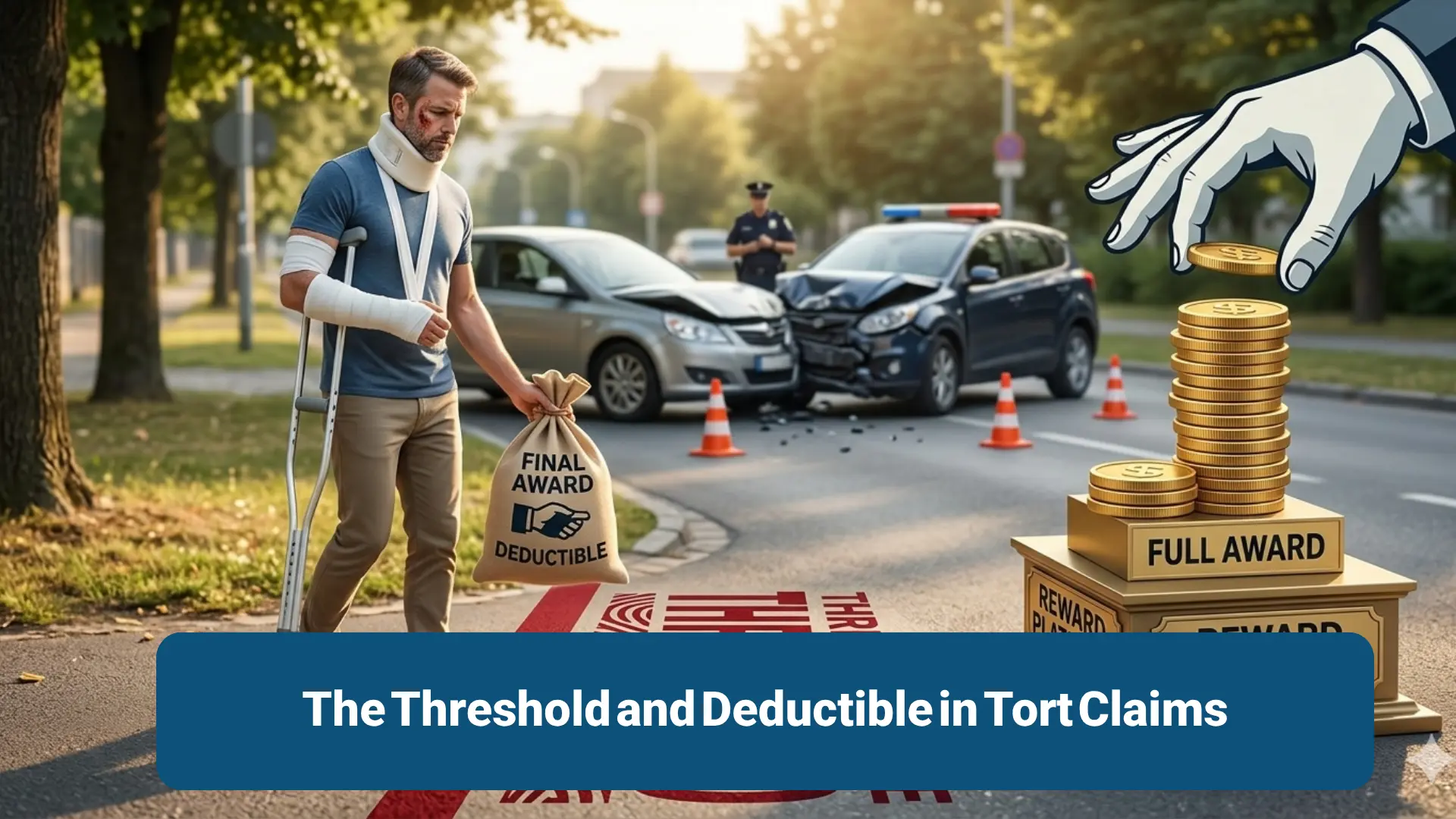
Not every injury qualifies for pain and suffering compensation.
Ontario law requires claimants to meet a legal threshold, meaning the injury must result in:
- A permanent and serious impairment of an important physical, mental, or psychological function.
If the threshold is met, compensation may still be subject to a statutory deductible.
The current deductible amount is $47,913.01 for general damages. This deductible does not apply if an award exceeds $159,708.71.
These numbers are adjusted annually for inflation.
Can You Receive Both Accident Benefits and Tort Compensation?
Yes.
Many accident victims pursue both types of claims simultaneously.
However, Ontario law does not allow double recovery.
This means that:
- Accident Benefits cover certain medical and income losses and;
• A tort claim may provide compensation for additional damages not fully covered by those benefits
In many cases, the tortfeasor will receive a credit for certain benefits already paid by the Accident Benefits system.
The exact interaction between these two claims may depend on the specific damages claimed and the benefits received.
Key Differences Between Accident Benefits and Tort Claims
Although they arise from the same accident, these two claims serve different purposes.
Accident Benefits
- Available regardless of fault;
• Provide immediate financial and medical support and;
• Subject to statutory benefit limits.
Tort Claim
- Requires proof that another driver was negligent;
• Pursued through a civil lawsuit;
• Focuses on long-term and non-economic damages and;
• Subject to legal thresholds and deductibles.
Understanding this distinction helps injured individuals navigate the claims process more effectively.
Why Many People Are Confused
Many accident victims assume that filing an insurance claim means they cannot sue the at-fault driver.
Others believe they must choose between Accident Benefits and a lawsuit.
In reality, these claims serve different legal functions and often operate together.
Because these systems interact in complex ways, mistakes early in the process can affect the final outcome of a claim.
Why Legal Guidance Can Be Important
The Ontario accident compensation system involves strict rules, deadlines, and documentation requirements.
Early legal advice may help injured individuals:
- Understand the benefits available to them;
• Avoid mistakes when dealing with insurers;
• Ensure injuries are properly classified and;
• Protect long-term compensation rights
Most personal injury lawyers in Ontario work on a contingency fee basis, meaning legal fees are typically only payable if the case is successful.
Insurance companies may attempt to reduce payouts through various strategies during the claims process.
Frequently Asked Questions
Do I have to choose between Accident Benefits and a lawsuit?
No. In many situations, both claims may exist at the same time. Accident Benefits provide immediate support, while a tort claim may address additional damages not covered by insurance benefits.
Can I still receive Accident Benefits if the accident was my fault?
Yes. Accident Benefits operate under Ontario’s no-fault insurance system, meaning eligibility generally does not depend on who caused the accident.
How long do I have to start a claim?
There are multiple deadlines involved.
You must generally notify your insurer within 7 days of the accident and submit an Application for Accident Benefits within 30 days of the accident.
Tort claims are typically subject to a 2-year limitation period from the date of the accident.
Final Thoughts
After a car accident in Ontario, understanding your legal options can make a significant difference in your financial recovery.
Accident Benefits and Tort Claims are two separate systems designed to address different types of losses.
Knowing how they work — and how they interact — can help injured individuals make informed decisions during an already stressful time.
If you’re unsure how Accident Benefits and Tort Claims apply to your situation, speaking with a lawyer early can help you avoid costly mistakes and protect your full compensation rights.


.svg)